By Rachel Hogue
This spring I had the privilege of working on the Williamsburg Bray School Records Project as part of the Bray School Lab’s first cohort of undergraduate student thought partners. We worked to unravel the stories of Bray School scholars, a valuable part of which was searching for material culture references to the tactile dimensions of the students’ studies and lives.
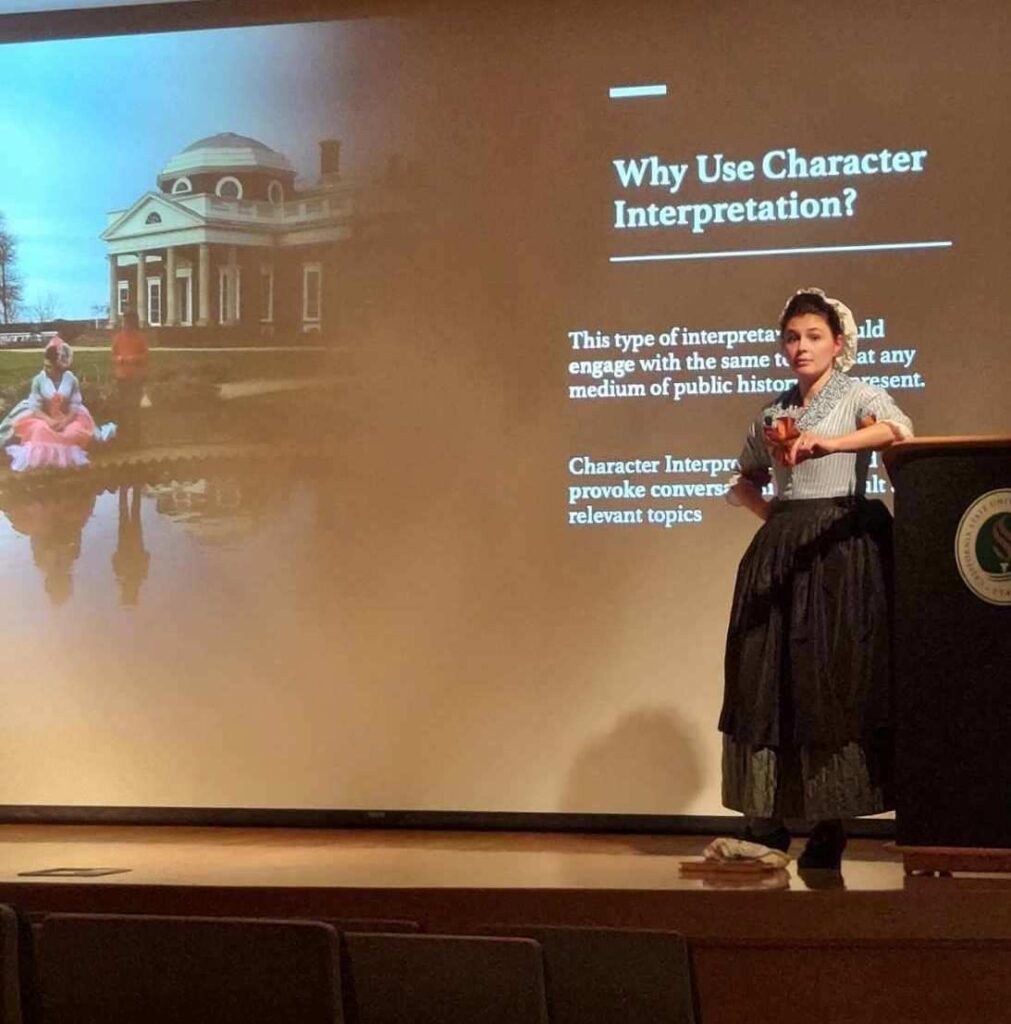
This summer I had the opportunity to seek answers about the material culture and lived experience of Bray School students through continual work in the Lab and an internship in the Historic Trades and Skills department at Colonial Williamsburg. I spent the summer interpreting for the public in the Margaret Hunter millinery shop while learning skills of a mantua-maker and milliner (18th-century dressmaking and accessory making). My work in the Bray School Lab, in hands-on trades work, and in the Rockefeller Library archives intertwined to reveal the community that surrounded the Bray School students and shaped their reality as enslaved children. When these interdisciplinary approaches to historical research were put into conversation, I was able to place students, households, fabrics, and stitches into context with one another. This research introduced me to Nancy and Squire, and here is part of their story.

Nancy is found on the 1765 Bray School student list as enslaved by a Mr. Charlton, most likely wigmaker Edward Charlton. Six years later, Edward Charlton married Jane Hunter, making Nancy not only enslaved within a wigmaker’s household but also a milliner’s. Both trades required sewing and “other such things,” which for Nancy could have meant laundry, reading recipes for removing stains, or the complex task of clear starching (an entire branch of 18th-century laundry to keep fine millinery crisp and clean). As a female student, Nancy would have been trained in labor-intensive skills beyond the work of reading and writing, specifically “knitting, sewing, and such other things.” Given the nature of her work and her education, Nancy probably had a workbag—a simple drawstring woolen bag common place in the 18th century—that she used to carry needles, thimbles, and other items on her daily walk between the Bray School and the Charlton household.
Therefore, during my summer internship I used 18th-century hand-sewing methods to approach a project I began to call “Nancy’s bag.” In 1789, a book entitled Dressing the Poor was published in England and gave instructions for clothing the white children of London’s charity “Schools of Industry” and recommended “Workbags as Reward” for the completion of a young girl’s first pair of knitted stockings. Nancy’s education and forced labor would have equipped her with nimble skills coveted by white gentry women—and yet her status kept her from legally owning that very labor. Nancy’s bag was made by carefully following the manual’s instructions: “mulberry wool…tape of the same color…and a white ticket marked with the name of the student.” Through the hands-on nature of this research project, I was able to glimpse the tactile nature of Nancy’s world.
Material culture and public history allow for historical imagining where historical justice can be imbued into objects presented to the public. A simple work bag can become a tool to discuss the paradoxes between enslaved labor and free white labor in the 18th-century British Atlantic world. I see “Nancy’s bag” as an act of reparation. If she was not given a bag with her name, she could have used the Bray School skills of reading, cyphering, and sewing to inscribe her identity on a bag of her own making. Today, when we as historians place Nancy’s name upon a tangible object, it starts to push her story, her identity, and her humanity past the biased lines of the written archive.
Squire also attended the Williamsburg Bray School in 1765 and was likely enslaved by Colonel Philip Johnson. A 1769 invoice tucked into a letter between Bray School trustee Robert Carter Nicholas and merchant John Norton indicates that Nicholas brokered the acquisition of 300 ells (40-inch lengths) of oznabrig for Johnson’s use in clothing his enslaved people. Maybe Squire’s share of the 300 ells was particularly coarse and scratchy—the thick cloth weighing down his shoulders and making him squirm in distraction while at school. When Robert Carter Nicholas wrote his expectations for teacher Ann Wager to keep the students “clean & neat in their Cloaths,” he also invoked that unpleasant oznabrig reserved for the enslaved community of which Squire was a part.

While the Bray School Lab guided my research as to what this clothing might be, my work in historic trades taught me the reality of how it might be by running my hand across oznabrig-like linen and feeling the unpleasant texture that would have dictated Squire’s movements and comfortability. If Squire chose, like other enslaved boys, to run through the streets of Williamsburg without all of their clothing, his choice held a gravity far greater than that of white children choosing not to be “neat in their clothes.” As Nancy and Squire moved throughout town, their names, households, and outward appearance would notify the town of their place as Bray School scholars. But their decision to wear or not to wear prescribed clothing could also reflect resistance to the oppression of Williamsburg slave society.
While the archive’s biases work to limit researchers’ ability to peer into the humanity, childhood, education, and enslavement of Bray School scholars, reading between the lines of the written record and placing sources like instruction manuals and invoices in conversation uncovers the lived experiences of these students. How they carried their tools and how their clothing felt against their skin shaped the reality of their everyday lives under enslavement.
Rachel Hogue ’24 is a history major at William & Mary.