by Keaton Drennan
When I began volunteering with the William & Mary Bray School Lab at the start of my senior year, I set out to research Johanna (also Joanna) and Clara Bee, former Williamsburg Bray School students, and other members of the Bee family. The Lab had already gathered some substantial information on Isaac Bee, establishing his immediate whereabouts and potential descendants after his time at the Bray School. However, I was drawn to the Bee sisters, especially given the scant information available about them. I wanted to answer some lingering questions: What happened to Joanna and Clara Bee after their time at Williamsburg Bray School? What happened to their sisters, Polly and Lydia Bee? I prepared for a difficult task, aware that my research would be stunted by the effects of historical erasure and the slow, gradual progress of digitization.
My research journey started with the 1782-1900 inventory of personal property tax records for Williamsburg, Virginia. I transcribed the tax documents for the years 1783, 1784, and 1786. From the transcriptions, I concluded that Joanna, Clara, and Lydia were in John Blair’s household in Williamsburg in 1783; Lydia and Joanna remained in John Blair’s household in 1784; and Lydia, Joanna, and a person named “Hanny” (potentially Hannah Bee) were recorded in John Blair’s household in 1786. However, there is a working theory from prior research that Hannah Bee and Joanna Bee may actually be the same person.
Mutual Assurance Society
After months of transcribing tax lists and digging through vital records and the Library of Virginia’s Virginia Untold collections, I finally encountered a research breakthrough. I entered the term “Polly Bee” in a general search through the Library of Virginia, which led me to a digitized collection of the Mutual Assurance Society of Virginia policies for Henrico County and Richmond City. The policies provide the locations of insured properties, the owners and occupants of said properties, as well as the valuations and building materials of each property. For those interested in genealogy research, architectural history, or learning more about Richmond City in general, I highly recommend consulting LVA’s Mutual Assurance Society records.
Polly Bee’s Journey: The Bees and Richmond City
Polly and Lydia Bee’s journey in Richmond began as early as 1798, with Lydia Bee residing at the property of Joseph Gallego, a flour mill owner and Spanish merchant. The sisters were residents on Gallego’s property in 1800, most likely living at the intersection of Cary and Main Streets, near the Bell Tavern, as informed by the Mutual Assurance Society Policies for Richmond City and Henrico County, 1796-1867.
Polly and Lydia were emancipated in 1802 by James Miller, a London merchant, while they were living in Richmond. After gaining their freedom, Polly and Lydia became part of the expanding free population in this city, and Polly herself would later play a role in helping others pursue their freedom as in the 1805/1806 emancipation of Eliza Ellis.
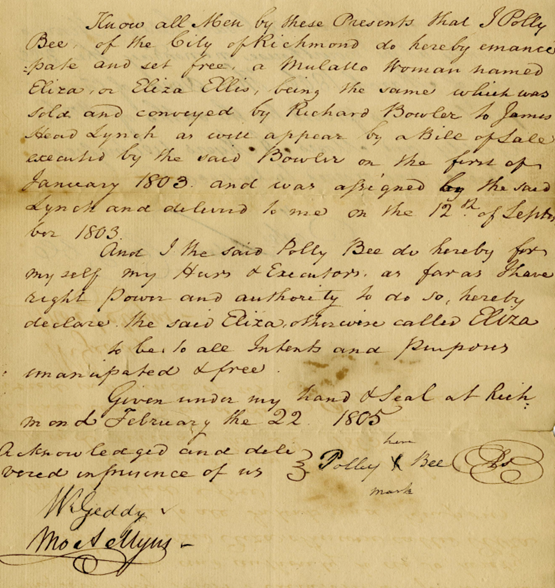
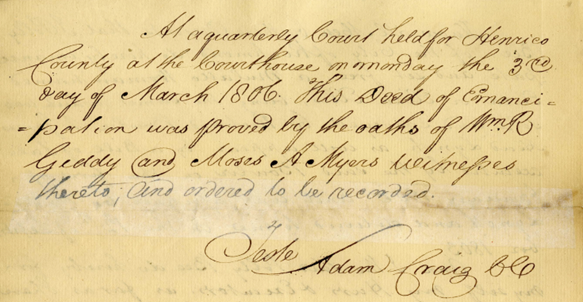
Mutual Assurance Society policies tell us that Polly continued to live in Richmond City following her emancipation. Polly Bee and her children William Bee, Elizabeth Bee, and Miller Bee— who take the surname “Bowler” in some records—owned property in the city from 1810 to 1829 as the “heirs of Richard Bowler.” There is uncertainty concerning the relationship between Polly and Richard Bowler; whether they were romantically involved or if their relationship was only of a legal nature is not conclusive. However, shortly after Richard Bowler’s death sometime between 1805 and 1810, Polly Bowler and her children inherited his property in the city. The Virginia Argus in October 1810 recorded that she petitioned the General Assembly for the right to manage the property she inherited for her and her children:
“[It’s] hereby given, that I intend to petition on the next General Assembly of Virginia, for leave to dispose of some real property in the city of Richmond, devised by the late Mr. Richard Bowler [for] myself and children, for the purpose of vesting the money arising therefrom in other real property in said city. Mary Bee.”
At the time of the petition, William, Elizabeth, and Miller Bee owned property, which was formerly Richard Bowler’s, on Main Street near Bell Tavern. After the initial petition, Polly Bee continued to defend her and her children’s property rights. A newspaper article published in The Enquirer in January of 1813 details a court case involving the Bees as defendants against John T. Bowler and William T. Bowler, presumably over the inheritance of Richard Bowler’s estate.
Reflection
My time with the Bee sisters did not end with the property petition or the Mutual Assurance Society papers. Newspaper clippings, commonwealth cause papers, registers, and personal property tax lists for Richmond City would provide many more insights into the Bees’ lives up until the 1830s. As I conclude my final year at William & Mary, I would like to express my gratitude to the Bray School Lab staff for the opportunity to be a part of a meaningful project and to express my hopes that future Student Thought Partners with the Lab will continue the research journey into the Bee family.

Keaton Drennan ’26, a senior at William & Mary, is double majoring in government and history. She has previous genealogy research experience during which she traced the descendants of individuals enslaved at Menokin in the 19th century. After graduating this spring, she plans to pursue opportunities in public history before applying to graduate programs in history.