My Musings of a Grown-Up Bray School Scholar

by Juanita Graham

Since I graduated from William  & Mary, a lot of information has been brought forth, via the college and Colonial Williamsburg, that pertains to the lives of persons of color. I appreciate the effort that has gone into expanding the general population’s knowledge about the often-overlooked people who worked and lived in the Williamsburg area.

As a person of color with a love for genealogy, I enjoy making connections between the past and the present, in order to bring enlightenment to the future. As a word artist, I also enjoy pulling words together to tell a story of those connections. After hearing Dr. Maureen Elgersman Lee present, “The Williamsburg Bray School and Its Scholars, 1760-1774,” on April 21,2025, my two joys of genealogy and writing collided. The result of the collision was a poem centered around the findings that were elaborated on during her engaging presentation. I entitled it, “My Musings of a Grown-up Bray School Scholar.”
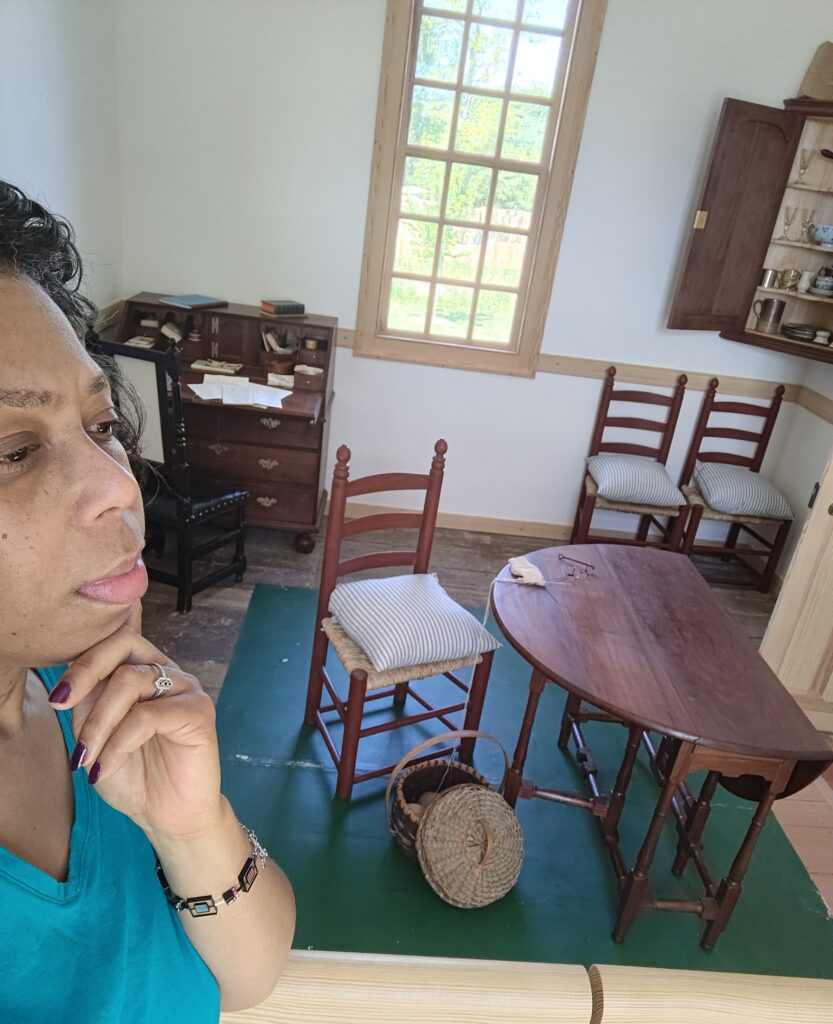
A woman stands in profile, pondering a room wooden, colonial-style desks and chairs.
Juanita Graham stands in contemplation, inside the Williamsburg Bray School, as she considers the history and legacies of its child scholars. Photo by Juanita Graham

The talk she gave stirred up a myriad of feelings, thoughts and questions for me, and as happens so often, my expression of all of those things came out in a poem.  It reflects my feelings, thoughts and questions … spoken as the potential musings of a grown-up Bray School Scholar.  In my imagination, I heard an adult Bray School Scholar speaking my thoughts. I heard my questions being asked and my feelings being expressed in the voice of a grown-up Hannah, George, Isaac Bee, Phoebe, Dolly, Edmund or Nancy. (These are just a few of the names of students that are recorded.)  I don’t know for certain if they would have wanted to know all of the same things because I recognize my thoughts and questions have the influence of me being a Gen X’er, but I’d like to believe that perhaps they shared at least one of my musings.

My Musings of a Grown-Up Bray School Scholar
Juanita Graham – April 25, 2025

How I was viewed I came to learn,
Was based on who was looking and why.
The varied perspectives of how I was seen,
Changed with the mind that was behind the eye.

Pupil …
Child …
Chattel …
Experiment … so some tended to think.

Investment …
Resilience …
A soul and an ancestor …
With both a divine and genetic link.

As a pupil I was expected to learn,
Then to share what I knew.
But I was not expected to use my knowledge,
To elevate my station, or to expand my reasoning as I grew.

I was to study my letters
So, I could learn to read the prayers.
So that my soul could be saved,
And I could gain freedom … once I climbed the heavenly stairs.

Now, I was told I would stay enslaved,
My freedom wouldn’t be on this side.
Hence, I wasn’t to get no ideas about breaking free,
Because they would surely have my hide.

For you see, I was also considered to be chattel ...
Isn’t that strange ... to be "a possession" with a soul?
A soul worth saving, that was in a body not worth freeing -
Liberation wasn’t the goal.

Which made me wonder if teaching us about the Lord,
Was really about fulfilling a Christian obligation.
Or was it to indoctrinate and to foster dependency and gratitude,
Thus, intensifying the process of subjugation.

You know, I was also puzzled and would like to ask …
Why didn’t the spiritual messages apply to you too?
Because you definitely did unto me,
What I know you would not have allowed to be done unto you.

That's not to say the religious teaching
Didn't help in some valuable ways.
It helped give me strength to make it through.
It also helped me keep calm - reminding me ... God repays.

Now, don’t get me wrong,
There were some kind and compassionate people involved,
Who didn’t see me as a school experiment …
Or just as a return on investment issue to be resolved.

However, regardless of whether I was seen as a person … or not,
I rejected the contrived idea that my natural ordained condition was that of a slave.
I have always been a person with core-deep resiliency,
Who will have a legacy that will live long after I am buried in my grave.

I don’t know them,
But I know in the future there will be descendants connected to me,
Who will proudly embrace me for who I am,
Even celebrating that I am a part of their rich and layered ancestry.

So, as far as the return of investment goes,
By your criteria, I don't think it worked out so well for you.
But, by my standards of having my story live on,
It will be a future generation’s powerful blessing that will continue … and continue…and continue.
© Juanita Graham, 8/2025

Author Juanita Graham has a strong connection to the Williamsburg area.  She is an Associate Minister at the historic First Baptist Church in Williamsburg, an alumna of William & Mary, a member of the Advisory Board for the Let Freedom Ring Foundation, a board member of the Williamsburg Book Festival, and the Director of Outreach Service for a local service-based non-profit organization.
History is Storytelling: Commemorating Hannah, Squire, and Sarah in the W&M Bray School Lab

by Tyler Lewis

Throughout Summer 2025, I had the opportunity to work as an intern for the W&M Bray School Lab with Genealogist Elizabeth Drembus, as part of the Office of Strategic Cultural Partnerships’ Cultural Heritage Immersion Program (CHIP). I engaged in genealogical research for three Bray School students: Squire of the Philip Johnson household as well as Hannah and Sarah of the Robert Carter Nicholas (RCN) household. These research endeavors were truly like a roller coaster that took the story of the scholars and their enslaved communities far beyond Williamsburg. Moreover, I recorded the names of every enslaved individual in the Johnson and Nicholas households to grasp a better understanding of their enslaved communities.

Squire and the Philip Johnson Household

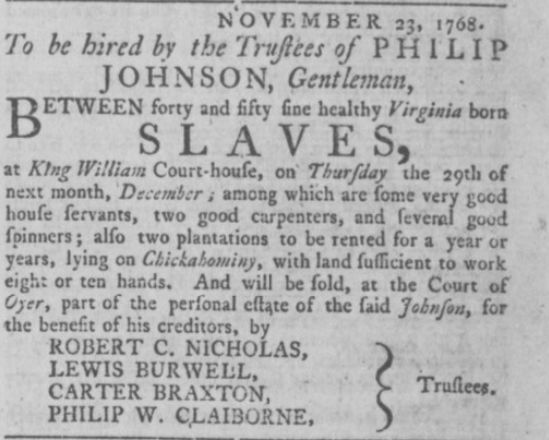
In 1765, Squire attended the Williamsburg Bray School, with Colonel Philip Johnson listed as his enslaver. Out of the three scholars that I researched, Squire had the most consistent paper trail. Legal documents and tax records placed him in the households of Philip Johnson and Sarah Johnson Lester (Johnson’s daughter) from the 1760s to 1792. While conducting this research, I wondered if there was something about Squire—either his skills, a connection to the Johnson family, or a high level of trust from the Johnsons—that made him seem worthy of receiving an education or remaining in the family.   This is of particular note, since Philip Johnson was heavily in debt from the 1760s up to his death in 1789. Johnson and his trustees regularly advertised auctions and hiring out of enslaved people in the Virginia Gazette newspapers. We can only imagine how Squire felt while constantly facing separation from his relatives and other members of his enslaved community. Johnson shuffled or sold his enslaved people throughout numerous Tidewater and Piedmont counties. Squire’s Bray School instruction in reading and spelling would have enabled him to read about the annual divisions and sales taking place within his community.

Hannah, Sarah, and the Robert Carter Nicholas Household

In 1762, Hannah attended the Williamsburg Bray School as a student (aged around 7 years old) from the Robert Carter Nicholas household. Unfortunately, Hannah was the most elusive of the three scholars, as the only other definitive supporting document is Nicholas’ 1765 letter to Reverend John Waring of the Bray Associates in London. In the letter, Nicholas complained that despite Hannah attending the Bray School for three years, she turned out to be a “sad jade” amidst his attempts to reform her. I interpreted the letter as Hannah’s education transforming her from a passive recipient to one who courageously developed her sense of self. Meanwhile, Nicholas lamented that he lost control of Hannah and how she defied the school’s purpose (in Nicholas’ perspective) of indoctrinating Black children to embrace their fate in bondage.

In 1769, Sarah attended the Bray School as another student from the Robert Carter Nicholas household. Bruton Parish Baptism records describe Sarah’s family unit, with Lucy as her mother and Caesar as her younger brother. Sarah’s story also reveals many complexities regarding slavery, in terms of her tasks and who exactly enslaved her. By the 1780s, Sarah and her family labored on Nicholas’ Westham Plantation in Henrico County. However, Nicholas’ 1780 will contained a clause that divided all enslaved people at Westham who worked in the house between his sons Lewis and Philip, while his estate would continue to enslave those in the fields. Henrico tax records only list Nicholas’ estate without Sarah, yet she appears in court records discussing the enslaved people from Westham who were partitioned to Nicholas’ sons. This discrepancy leads me to believe that Sarah conducted domestic tasks while Lucy and Caesar cultivated cash crops.

Virginia Gazette (Rind, Williamsburg, VA), November 24, 1768, p 2.  Courtesy www.newspapers.com.

Researching Hannah and Sarah taught me the importance of persistence in genealogical research. I had to document the enslaved communities and land speculation efforts for RCN’s children that stretched across various counties throughout Virginia, Kentucky, and New York. Frequent discussions of weavers in factories (in Albemarle, Virginia, and Geneva, New York) made me think of sewing and embroidery taught at the Bray School. Furthermore, various legal and personal papers for Nicholas’ children listed multiple enslaved women named Hannah or Sarah, which further complicated this research.                    

 Reflection

I thoroughly enjoyed this summer internship because it perfectly encapsulated the Bray School Lab’s interdisciplinary nature in highlighting the students’ stories. It was also incredible to work within an extremely supportive environment alongside the Descendant Community, fellow CHIP co-workers, Bray School Lab supervisors, and other institutions. As an African-American man, it felt very gratifying to witness the passion of descendant communities in the Williamsburg area, Charlottesville, and throughout the country using genealogy to uplift our enslaved ancestors as heroes and agents in American history. In particular, engaging with the festivities on Descendants’ Day at James Monroe’s Highland revealed how institutional and descendant collaboration can highlight the importance of storytelling and humanize the experiences of the enslaved.

This image has an empty alt attribute; its file name is Tyler-Lewis_headshot_Bray-School-opening-6-19-25-Grace-Helmick-1-741x1024.jpg
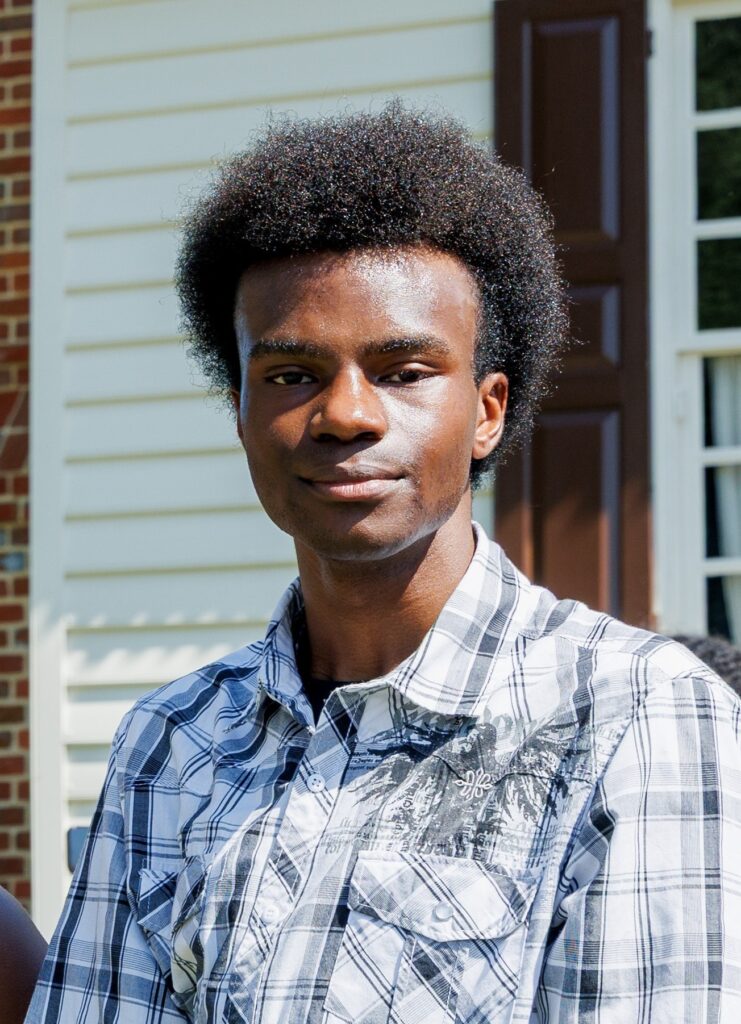
Tyler Lewis on Bray School opening day, June 19, 2025 (cropped);
photo by Grace Helmick, W&M Strategic Cultural Partnerships

Tyler Lewis ‘26 is a William & Mary senior, studying history & anthropology. His previous genealogical experience includes researching enslaved communities for The Valentine Museum (Richmond, Virginia) and within his own family (with counties across Southside/Tidewater Virginia and the Carolinas). Tyler is continuing his research on Hannah, Sarah, and Squire this fall semester under the NIAHD Internship in Public History.